MondayVatican
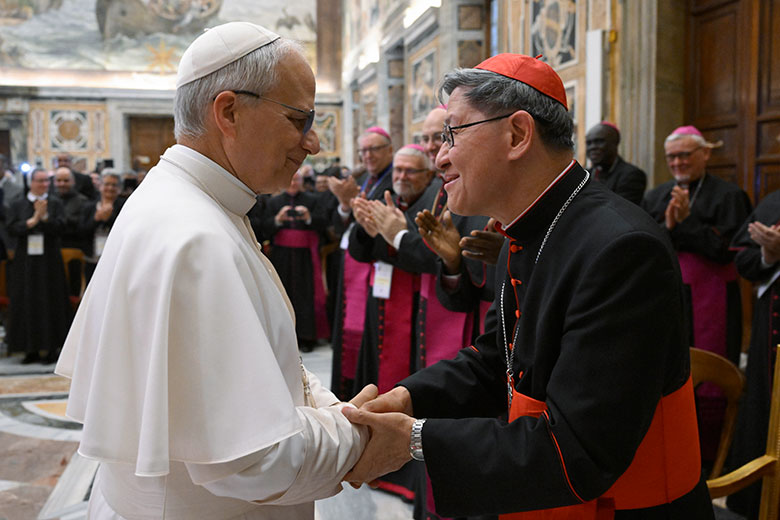 By appointing Archbishop Vittorio Francesco Viola as Archpriest of St. Peter’s Basilica and Cardinal Luis Antonio Tagle as Dean of the College of Cardinals, Leo XIV marked the transition to a new generation and, probably, a new era for the Church.
Not only were the two choices largely unexpected, but, ultimately, so were all the decisions Leo XIV has made thus far. These two appointments demonstrate that the problem isn’t simply interpreting the Pope with old categories. Rather, it’s believing those old categories still hold.
It is also interesting that these appointments came on the eve of a surprise announcement that the Pope will undergo surgery this week after a lump was found in his lung. The Pope seems to want to leave the house in good order, though this seems like an easy surgery, and Leo might be back in action as early as next week.
Ultimately, Leo XIV himself is a Pope of the new generation. Ordained in 1982, he did not experience the Second Vatican Council’s diatribes firsthand. He is a priest with a solid liturgy, yet born of the Council, and he has never celebrated or even had any inclination toward the ancient liturgy. Leo XIV is not a progressive Pope, as progressives have been defined in recent years. Nor is he a Third World Pope, despite his missionary experience. But obviously, this Pope’s friendships and inclinations are with a new, different generation, with different priorities, and completely outside the conciliar debate.
How do these two appointments by the Pope demonstrate this reading?
Let’s begin with the appointment of the new archpriest of St. Peter’s Basilica, who is also the Pope’s Vicar for the Vatican City State. Vittorio Francesco Viola arrived as secretary of the Dicastery for Divine Worship with a reputation as a progressive priest and a supporter of Annibale Bugnini’s liturgical reform, which traditionalist circles strongly contested. He therefore represented the type of bishop Pope Francis could favor to silence those who wanted to continue celebrating with the Ancient Rite, that is, the one prior to Paul VI’s reform.
In short, Viola was considered instrumental in the reform of Pope Francis, who wanted to completely erase the ancient rite, and who, for this reason, had also replaced Cardinal Robert Sarah, who had retired, with Cardinal Arthur Roche, who had been the “arm” that had drawn up the Pope’s instructions against the traditional Mass.
But Viola isn’t just this. He’s also the kind of bishop Leo XIV came to appreciate. He’s considered harsh in his manner, and not easygoing with the personnel, but honest. Some call him ideological, but he’s straightforward nonetheless. Above all, he’s not visible, and in this, he mirrors the Pope’s other choices, such as that of Archbishop Iannone as his successor at the Dicastery of Bishops. Not only that, Viola doesn’t favor traditionalism, but he celebrates Mass rigorously, with an impeccable liturgy.
In all this, he also reflects Leo XIV’s thinking. In recent years, the Pope has signaled a relaxation toward those who wish to celebrate outside the ancient rite, not by “strengthening” Traditionis Custodes, which barred any liberalization of the old rite, but by agreeing to authorize usus antiquior celebrations. However, he never said the Church should return to traditionalist Mass, and he did not give in when the issue of tradition was used as a tool to introduce other themes into the Church. The firmness with which the Pope responded to the Lefebvrist when they decided to ordain bishops without a pontifical mandate clearly signals this.
But Viola’s pick for a promotion was also understandable, since he was already being discussed as a cardinal, and many thought he would end up leading the Dicastery for the Causes of Saints. In short, Viola’s appointment is surprising, given the rumors pointed in a different direction, but not entirely surprising, since he was a popular prospect anyway.
It remains to be seen whether Viola, a Minor Franciscan succeeding a Conventual Franciscan like Cardinal Gambetti, can restore order to the management of St. Peter’s Basilica. All things considered, however, it is a logical appointment.
The choice to appoint Cardinal Luis Antonio Tagle as dean is also surprising. Pope Francis had wanted the dean of the College of Cardinals to no longer serve for life, but then refused to let the cardinals vote when Cardinal Giovan Battista Re completed his term and needed to be replaced, Francis confirmed Re in his position in January 2025, a few months before he died. It seemed almost certain that Cardinal Pietro Parolin would be chosen. Parolin, in the end, acted as a Dean during the conclave, as both the Dean Cardinal Re and the sub-dean, Cardinal Leonardo Sandri, were beyond 80. Cardinale Parolin was however the dean in the Conclave, since he was elevated to the rank of Cardinal Bishop in 2018, while Cardinal Tagle was given the rank of Cardinal bishop in 2020.
A little explanation is needed here. Cardinals are divided into ranks based on an ancient functional division: cardinal deacons, cardinal presbyters, and cardinal bishops. Cardinal bishops, the highest rank, used to number at most seven because they are linked to the ancient suburbicarian dioceses of Rome. In practice, they were cardinals who served as bishops and were distributed across seven dioceses connected to Rome. Each cardinal bishop takes a titular church, while the dean always gets the title of Ostia. However, the title is added to the titular Church.
Paul VI decided to also consider cardinals who were patriarchs of the Eastern Catholic Churches sui iuris as cardinal bishops.
Pope Francis expanded the college of cardinal bishops by including five other cardinal bishops who retained their titular see and were elevated to cardinal bishop ad personam. When a titular cardinal dies, the title of cardinal is no longer a cardinal bishop. Cardinal Parolin was one of the cardinals co-opted into the order of cardinal bishops.
Voting for Parolin under Pope Francis was natural, considering that Parolin was the balancing act in a difficult pontificate, and because he was the most ancient cardinal in the ranks of the bishops and not of retirement age. But today, with a new pontificate, the cardinals have looked to the traditional college of cardinal bishops, and, after all, Cardinal Tagle holds the title of Albano, one of the most important, inherited from Cardinal Prevost, now Leo XIV. In addition, Cardinal Tagle was created a cardinal before Cardinal Parolin, in 2012, at the last consistory held by Benedict XVI.
But Tagle’s choice, confirmed by Leo XIV, speaks volumes. At the helm of the College of Cardinals is a cardinal with no Curia career, who reached the pinnacle of his career elsewhere and comes from the other side of the world to lead the Dicastery for the Evangelization. Tagle’s profile, the first Asian cardinal appointed dean, is not that of an institutional cardinal, one who understands the institution’s rules, history, and structures, but rather that of an outsider, a cardinal who brings to Rome his experience of the mission and the Global South.
Ultimately, it reflects the 2025 conclave, where the Roman Curia’s presence was significantly reduced and English was, for the first time in history, the lingua franca. But it also reflects the profile of Leo XIV: a Pope attentive to the institution and its symbols—and, in this, typically Western and North American—but also a Pope of a new generation who values personal relationships and, in any case, looks beyond institutional history.
These two appointments ultimately mark the beginning of a new world. A world that certainly won’t return to tradition, but that won’t necessarily mean the dawn of progressivism.
The Pope is now called to fill other Curia positions, and it will be interesting to see how he proceeds. Meanwhile, however, generational change is underway, and people will likely interpret it not through the lens of ideas or ideology, nor as marking continuity or discontinuity. There will be continuity, because Leo XIV’s generation has held responsibility and strength since Pope Francis. There will be discontinuity, because Leo XIV will then have to decide what to focus on most and what his priorities will be. Only then will we see whether the Pope intervenes, lets things happen, and for how long.
For now, we can simply note that a new generation has begun. A new world will emerge, though it’s hard to say what it will be.
Condividi


3 Responses to Leo XIV and the new generation
Lascia un Commento
Get in touch



Cardinal Tagle was indeed a Cardinal Bishop during the conclave having been elevated to that rank by Pope Francis on May 1, 2020 along with Cardinal Stella. Leo gave him the Cardinal Title of Albano, which was destined for him, but he hadn’t held it long enough before being elected Pope to ever take possession of it.
Grande! Niente a che vedere con quanto scrive Capozza, che si limita a commentare i.bollettini vantandosi di aver azzeccato in anticipo (ma per via delle sue talpe),
I always enjoy the way Mr. Gagliarrducci writes. Not only does he inform, he sets a foundation for the informing with ideas and questions the reader might ask about. I will call it depth.