MondayVatican
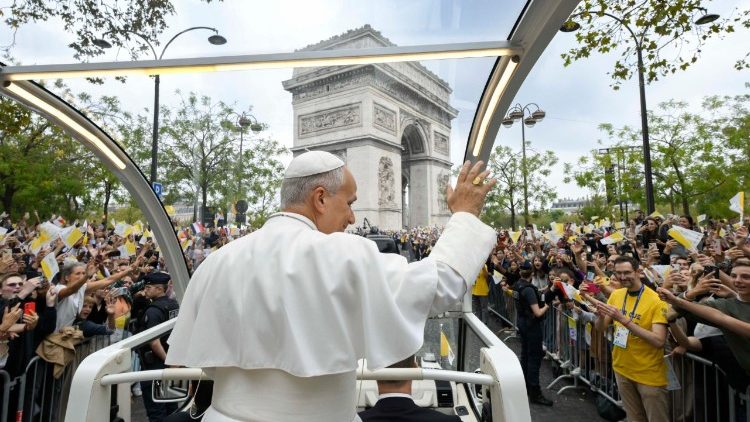 Last June, when asked in a private meeting about Leo XIV’s expectations and ideas for Europe, the Pope replied: “Wait for my speech in Metz.”
That speech, which will be delivered on Sep. 28, has been honed down to the last detail, studied for months, and translated again for the last time the day before the trip.
The Metz speech is eagerly awaited, and it should be.
Leo XIV is visiting the home of the venerable Robert Schuman, the father of Europe, and above all the father of a vision of a Europe that is non-bureaucratic and non-bureaucratized.
Schuman, in fact, wanted to make “war impossible,” and he did so by bringing old enemies together and creating a network that would benefit everyone, so no one would have to seek a peace table after stirring up the winds of war.
At first, Europe was primarily an idea of a coal and steel exchange, but it gradually became a broader reality, built around many initiatives that even transcended the Iron Curtain.
The Second Vatican Council gave rise to the idea of a Council of European Episcopal Conferences, born from the intuition of then-Monsignor Roger Etchegaray, who, in a simple note, highlighted the many activities developing on the European continent.
Poland’s millennium celebrations led the Polish Episcopate to an extraordinary initiative: sending letters to all national episcopal conferences. And, in particular, the letter to the bishops of Germany, conceived by Cardinal Boleslaw Kominek, Archbishop of Wroclaw, has remained in history.
Poland had also been a site of the Holocaust, the German extermination plans that were horribly implemented in Auschwitz, precisely on Polish soil. Poland had been invaded by Germany, and Poland, fell into the Soviet sphere of influence after the war, sacrificed by the Europe it so loved.
The Polish bishops went beyond all that, and wrote to the German bishops, with a formula that has remained in the collective memory: “We forgive and ask for forgiveness.”
In short, a European world took root. Schuman’s vision found fertile ground in which to grow – and it did grow, despite the Iron Curtain. It even helped bring down the Berlin Wall, reviving the great dream of a Europe breathing with both lungs, East and the West, in the words of John Paul II.
Leo XIV, however, decided to begin not from Europe but from Schuman.
He went to France but did not stop in Strasbourg, where they were waiting for him at the European Parliament with an open and already accepted invitation. Leo did not visit the European institutions, but he looked at Europe for the first time through the eyes of one of Europe’s venerable men.
He may not use the expression “Christian roots,” but that is certainly the meaning of the pope’s presence in Metz today.
The Pope arrives in Metz after visiting Paris and Lourdes. French President Emmanuel Macron tried in every way to exploit the Pope’s trip for a photo opportunity , much like when, at the reopening of Notre Dame, he had his picture taken with all the leaders who had gathered in front of the cathedral, rebuilt after the 2019 fire.
The Holy See, however, stood firm. No honorary dinners or lunches, no Legion of Honor for the Pope—in fact, the pope never accepts individual recognition—not even Macron’s idea of being able to personally accompany the Pope for ten minutes in the restored Notre Dame.
This request, among other things, seemed intended to demonstrate that France still owns the cathedral.
While French churches are state property, the state also cannot interfere in religious matters, and Notre Dame is no exception.
Nor did Macron attend the Pope’s Mass, as his predecessors had done. Of course, Macron attended Pope Francis’s Mass in Marseille in 2023, but that was because it was the only way he could welcome the Holy Father.
Francis set foot on French soil three times as pope, visiting Strasbourg, Marseille, and Corsica, always emphasizing that he was traveling to specific events and places, not France.
Leo XIV, however, chose France as the fourth stop on a European journey that began in Monaco, continued through Spain, made a brief stop in San Marino, and finally reached the Church’s eldest daughter.
Two microstates and two large nations, thus far perfectly balanced, and a clear choice: To look to those places that Pope Francis considered the center of faith, and which Leo XIV instead seems to treat as the new existential peripheries.
Monaco is on the periphery, where the Prince refuses to sign the abortion law, and from where the Pope has launched an extraordinary appeal for multilateralism.
Spain is on the periphery, having rediscovered its cultural Christian identity with the Pope’s visit, but still having to contend with rampant secularization.
San Marino is on the periphery, a tiny nation that few consider, yet extraordinarily active. And France is on the periphery, where, among other things, an incredible rebirth of faith is taking place.
It is incredible even for the bishops, considering that the bishops of the Paris region have called a regional council to understand the reason for the enormous number of adult baptisms that have been continuously growing in recent years (24,000 on Easter night 2026).
France is a periphery of faith because its government has set aside the great Catholic ideas and welcomes Leo XIV with a recently approved euthanasia law, which does not even consider the possibility of conscientious objection for nurses.
The pope will restore balance in the dialogue between the Church’s leaders and the people, dot the i’s on doctrine, and thus strengthen the extraordinary number of Catholics hidden in France.
It’s a tremendous challenge.
Condividi


Get in touch



